Astronomy and Music


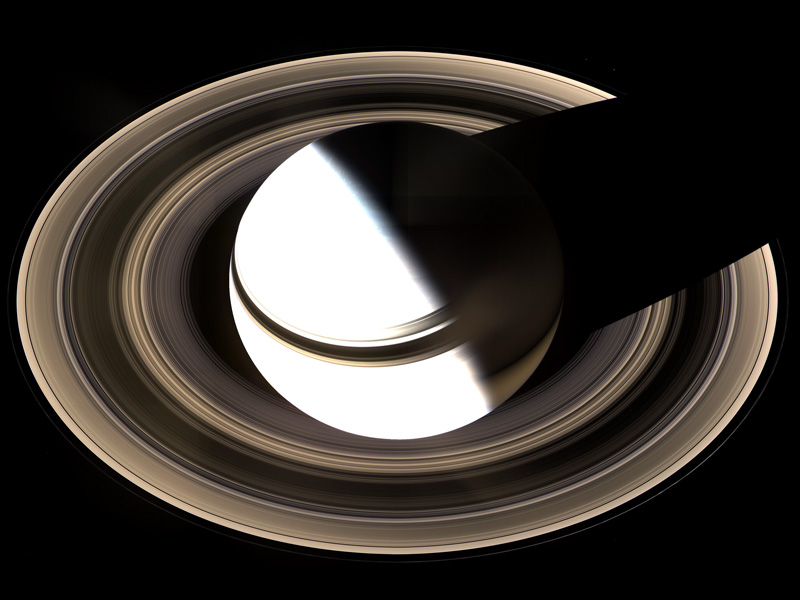
Two very enjoyable TV series are currently unrolling on the BBC, one on Astronomy and one on Music (two of the seven Liberal Arts, the first being traditionally regarded as the application of Geometry and the second of Arithmetic). They can be watched online, at least in the UK, and the associated websites provide excellent resources for educators. If you can't access them through the BBC, they are available as segments on YouTube. The Wonders of the Solar System by Brian Cox is full of spectacular scenery and special effects, and suitable for all ages. If this doesn't turn your children into astronomers, nothing will! Episode 2 was all about order out of chaos, the "beauty and symmetry that lies at the heart of the universe", and featured spectacular shots of Saturn's ring system. Sacred Music presented by Simon Russell Beale is glorious in a different way. After a recent episode I am a fan of Anton Bruckner, a devout Catholic contemporary of the better-known Brahms. This is the second series already, but presumably the whole thing is available on DVD. Do take advantage of the availability of these programmes if you can. For a better view of the Saturn picture above, go here.

How the World Is Made?


One of the topics in my book is so-called "sacred geometry". I didn't do it justice, of course. It need a lot more, and better, illustrations, but that wasn't an option at the time. So instead, as readers will know, I recommend the work of educator Michael Schneider. He seems to strike the right balance of enthusiasm and sanity, and his book is full of nice pictures and geometical constructions. Unfortunately, sacred geometry and number along with numerology and astrology have become a playground of the New Age. But while this should certainly engender caution, it should not put orthodox Christians off completely. These symbolic systems are part of the great Classical and Medieval civilization and were employed in the writing of Scripture and the building of the great cathedrals. We need to understand them better. The two great modern masters of the subject are Keith Critchlow (who teaches at the Prince's School of Traditional Arts) and John Michell. Shortly before he died, Michell completed How the World is Made, which is recommended by Michael Schneider. The book is illustrated by Michell with full colour images like these, and is published by Inner Traditions in the US and Thames and Hudson in the UK. I hope to review it in Second Spring, where I will try to say why I think the subject is important, even though I have to attach a strong warning, because it is mixed together (as you will see in Michell's book) with a lot of eccentricity and downright anti-Catholic prejudice.

Homeschooling


This blog has become a bit of a jumble - partly because the topic of education is so broad it touches on everything.  I have added a list of relevant links and postings on the left under 'Schooling etc.' There you will find some material on Homeschooling, Unschooling and Primary Schools. I am in touch with a number of small groups of homeschoolers around the U.S. who are trying to develop novel and interesting approaches. Charlotte Osterman's group is working on the question of how to use geometry to foster "poetic knowledge" in children - see the "Holy Geometry Project" under Ideas of what to use with kids in the left-hand column. Meanwhile Katie Kimball and others are working on the idea of Kitchen Stewardship - i.e. looking practically at ways to "balance God's gifts of time, health, earth and money" (on a small budget). I am also speaking with groups thinking radically about the curriculum in primary schools, and how those schools might work more closely with parents, who are - the Church teaches - the first educators of their children, whether they like it or not. And it seems to me this whole discussion must be connected also with attempts to apply John Paul II's Theology of the Body to education, both at home and in school. This offers a holistic approach to building a culture of life on the basis of a new and profound understanding of human nature. More on that another time.

Song of the Angels

“'The angels sing praise to the Creator, and in doing so, they, with Holy Wisdom, bind and heal the created order.' ...It is this song of the angels that we should listen out for, now that the coming of Christ has reunited humanity with the celestial liturgy that Adam heard before the fall."
In this way the Telegraph columnist, Christopher Howse, concludes his very fine piece about the Archbishop of Canterbury's Lent book this year, Lucy Winkett's Our Sound is Our Wound. The book is not all about the Angels (please read the full description), but the remark caught my eye since it connects so directly with the themes of Beauty for Truth's Sake, and with earlier postings on this site, such as this one on Sacred Music, this on the Music of Creation in Tolkien, and this on the Sphere of the Angels.

If this Lent Book is as good as last year's - Timothy Radcliffe's brilliant Why Go to Church? - it will be well worth reading in the weeks ahead. And it certainly sounds so from Mr Howse's description.

Primary education


The question of reforming Catholic education at every level should not be reduced to an ideological battle between Left and Right. It is not a matter of adding some more or different religious instruction or imposing a more rigorous moral code within the school. The defects of Catholic education run deeper than that. We need more effective religious instruction, of course, but we also need holistic educational reform across the board. In our quest for wholeness we should study and learn from what has been done and suggested by the progressive education movement, both here and within other countries and other religious traditions. Whatever we decide to do, it will be governed by our anthropology - what we believe about the human person, and about the child. So what might primary education look like, if shaped by an adequate anthropology? Read on... 


Photo by Rose-Marie Caldecott

Simplexity


The world as a whole is complex, but it is also a unity. It is “simplex”, founded on simple principles. Poets, painters, scientists and mathematicians are all searching for simplexity in their own way. Aesthetic pleasure is very largely the delight we feel in seeing order, meaning and relationship – the beauty that Coleridge called unity in variety. But it has to be an order unforced, seemingly spontaneous, rather than brutally imposed upon the material. The world as a whole is beautiful in just this sense.

Modern science describes the world as to a large extent “self-organizing”, because sophisticated and unpredictable patterns are now thought to emerge spontaneously from the indefinite repetition of simple algorithms. Furthermore they do so without violating the law of entropy. Evolution is then held to account for the refinement of those patterns through the process of selection. None of this - if true - is incompatible with theism (although it makes Intelligent Design look a bit foolish). The Christian God is the principle of existence itself, the creator without whom there would be nothing either simple or complex to admire. (For the compatibility of theistic faith with an up-to-date cosmology see Stephen Barr’s Modern Physics and Ancient Faith, reviewed here.)  If with complexity emerges unpredictability, this merely highlights the possibility of a higher-level order we call providence, governing coincidence and chance. God is the principle of order, and thus the ever-present source of unity as well as diversity.

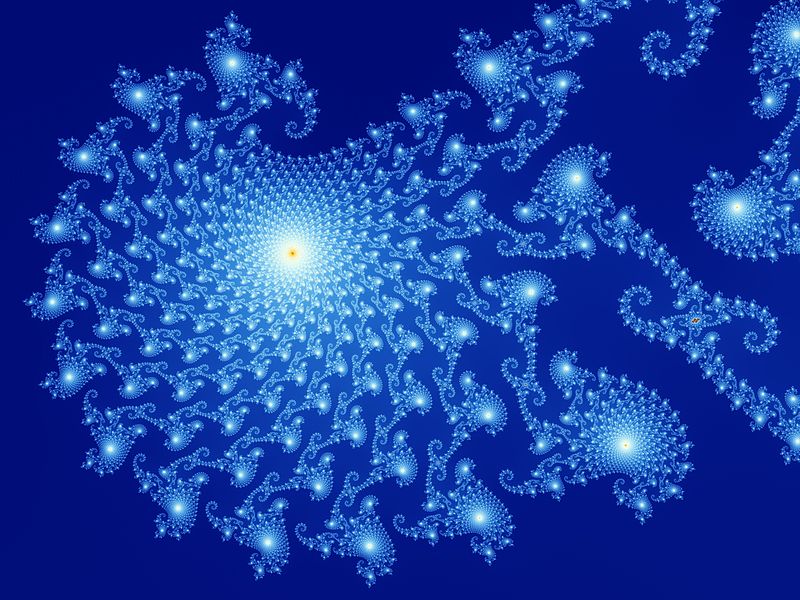
If science interests you, take this awesome trip through the known universe. (The image above, by the way, is a fractal from Wikimedia Commons. For more on fractals see this clip on fractals in Africa.)

Music of Creation in Tolkien

“There's a divinity that shapes our ends, Rough-hew them how we will." (Hamlet V.II.)

Both C.S. Lewis and J.R.R. Tolkien saw the creation of the world as taking place in some way through music. Readers of the Narniad will recall Aslan singing Narnia into being in The Magician’s Nephew. As for Tolkien, he composed a whole “Elvish Book of Genesis” in the form of the Ainulindale, the opening section of the posthumously published Silmarillion, describing the creation of the world by the One God (Illuvatar). In that mythological account – which he believed to be compatible with the creation story in Genesis – God first proposes the world as a musical theme, which
he gives to the Angels (the Ainur) to develop and express, much as a composer might give the score to an orchestra – although a jazz analogy might be more appropriate, given the amount of improvisation the players are allowed. One of the Angels, Melkor (Lucifer), tries to force the music in another direction, but his rebellious dissonance is finally integrated within the whole design, much as in the real world evil is at first tolerated and eventually becomes the occasion for a greater good that could not have been anticipated. But this is not yet the creation proper, only the composition of the music “which is over all”. Now God turns the music into light, and shows the Angels the world in a vision in the Void. But even this is not yet the creation. That takes place when music and light become Being through the Word of Iluvatar, “Ea! Let these things be!” God sends into the Void the Flame Imperishable (Holy Spirit) which forms the heart of the world and sustains it in existence.

As I remark in my book Secret Fire (or if you are in America, The Power of the Ring – that change of title was not my idea!), drawing on A.K. Coomaraswamy, Fire or “Agni” (in Latin Ignis) is one of the names of God in the ancient liturgical hymns known as the Rg Veda - a spiritual Sun whose rays are the Devas or Angelic Powers (“And sundry sang, they brought to mind the Great Chant, whereby they made the Sun to shine”). Agni is the giver of the Spirit (Breath), a “formal light that is the cause of the being and becoming of all things”. Coomaraswamy sees a connection here with the teachings of Heraclitus. He also points out a linguistic “equivalence of life, light, and sound” in the similar roots of the words for “to shine” and “to sound” – a connection present even in English when we speak of “bright” ideas and “brilliant” sayings.

Tolkien’s mythological construction has deep roots – less, I suspect, from the study of Indian religion than from the implications of philology (he being a seer who, one person rightly said, had gone “inside language”). Also he was theologically better informed than you might think, since one of the great theologians of our age, Louis Bouyer, was a close friend and admirer, according to important research by Michael Devaux. It seems that for Tolkien, the creation is envisaged in three stages - music, light, and being - corresponding in some way to the Father, the Son, and the Spirit. Yet the whole Trinity is involved in every stage, and the Logos or Word, who is the Second Person of the Holy Trinity, can justly be called the order, harmony and meaning of the cosmos, revealed to the Angels but only expressed in creation through the Breath of God.

Illustration shows the 2004 edition illustrated by Ted Nasmith.