The Golden Circle

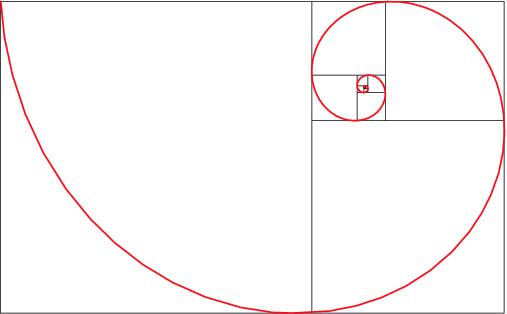
In chapter 4 of my book I talk about a rectangle inscribed within a circle. Naturally there are an indefinite number of such figures. Take the diagram on the right, kindly produced by Michael Schneider. Look at the outermost circle, and the largest rectangle that lies inside it, touching its circumference at A, B and C. You could move points A and B nearer to the left-hand end of the horizontal diameter of the large circle, or else push them further apart towards the two ends of the vertical diameter, producing an ever-thinner oblong shape. Halfway between these  extremes the rectangle would become a square. But the shape Michael has drawn is a Golden Rectangle, so we can call the whole figure a Golden Circle ("Golden" because of the presence of the Rectangle). The G.R. is famous for being the "most beautiful" of rectangles, possessing the peculiar property that its sides are in the ratio of 1 to Phi (1.618...), so that if you cut off a square portion what remains is a smaller Golden Rectangle - and so forth, forming a logarithmic spiral, as in the following image.

When I wrote the book I was intending to use the Golden Circle as a way of exploring the relationship between Pi and Phi, but I never got around to it. My reason for being intrigued is simple. What we learn from Simone Weil - and what she learned from the Greeks - is that geometry is full of theological meaning. We have forgotten how to make those connections. It is not that we can prove the Trinity or the Incarnation with diagrams, but that the mathematical world is full of analogies that echo theological and spiritual truth. You might even say that mathematical necessities are a portrait of divine freedom, since in God freedom and necessity coincide. The beauties of geometry and arithmetic are a world of metaphors and help to raise our minds towards the contemplation of divine truth. My book only touches on this, but a much fuller and richer account is given by Vance G. Morgan of Providence College in his book Weaving the World: Simone Weil on Science, Mathematics and Love, reviewed here.

Analogy


The use of analogy is fundamental for human thought and language, and in particular for theology. Derived from the Greek analogia "proportion" (ana- "upon, according to" + logos "meaning" or "word"), it refers to the way we compare one thing with another on the basis of some likeness or similarity. It is more complicated than a simile, which happens when I straightforwardly compare one thing to another ("God is like a light"). It is also more complicated than a metaphor, which is when in poetic language I simply assume the similarity in the way I describe something ("God is a light for my eyes and a path for my feet").

An analogy is built out of similes and metaphors - it extends them not just to things but to relationships between things. If a simile is like a ratio (A : B), an analogy is a ratio of ratios (A:B : C:D, or "the relationship of A to B is like the relationship of C to D"). So to form an analogy we might say, for example, "Clay is to the potter as the world is to God". But "analogy" is also used more generally to cover all the ways we compare things that are similar to each other in some respect but not others. Everything we say about God relies on metaphor and analogy, because the words we use necessarily come from the things we can see and touch.*

So God-talk has to be taken with a pinch of salt. When we talk about God we mustn't take ourselves too literally. There is an analogy here with the problem of "graven images", or the temptation to mistake the image for what it represents. But what if God talks about God? In Jesus, we believe, God spoke as a man. Just as the Incarnation gave a justification for icons, so it gave a justification for saying certain things about God and believing them to be true. Philosophy and mysticism were possible before Christ - but now there is also theology. The things in the world were always "like" God in certain ways, not just as signs of his presence and activity but as expressions of his nature, or natural symbols of him. But now they can also be sacraments and sacramentals.

All of this perhaps serves as background to the use in my book of geometrical and mathematical "analogies" to the Trinity. Thomas Aquinas was perfectly clear on the fact that the Trinity cannot be proved by anything in nature - nevertheless, once we know by revelation that God is triune, we can see traces or impressions of the Trinity everywhere. So, for example, all things (1) subsist, (2) have a definite form, and (3) are ordered to an end (echoing Father, Son and Spirit). Following Simone Weil, I wanted to show that fundamental numbers and shapes also "echo" the Trinity in this way. There is no attempted proof here, just an intellectual intuition or an aid to contemplation, but the point is that knowledge of the Trinity enables us to appreciate the beauty of creation by seeing in its ordered harmony a meaning that we could not know before. Mathematics, in its own way (and you won't hear this said too often!), is a picture of love.

* There is much talk in theology about the "analogy of being", or attempts to compare the existence of God and that of the world. For an interesting discussion of that topic go here.

The photograph is by Tom Bree and is used by kind permission.

Exploring patterns

If you enjoy geometrical patterns or colouring or even if you are contructing a tiling system for your kitchen or bathroom, you might want to look at this site from Altair Design. Teachers and parents might like to look too, to see some activities to get kids painlessly interested in geometry. Explore the site - it has a huge variety of patterns that you can colour online, a competition you can enter, and a gallery of the best examples done by other people. The middle button at the top gives you some history and context for the site.

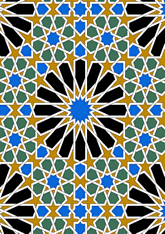
I also recently stumbled on some nice tiling patterns based on Escher's drawings in the Alhambra (one of which is shown in the picture). If you go to the page via the link, click on the individual patterns and you'll open up some spectacular PDFs.

Symmetry


Symmetry is one element of beauty, and in the book I describe how a physicist attempted to locate all particles on a grid consisting of the most symmetrical object conceivable – and failed. Does this failure disprove the coinherence of beauty and truth? Hardly. For in fact a slight departure from symmetry can be even more beautiful. This is true at many levels. In the early moments of the big bang, if matter and antimatter had been exactly balanced the universe would have destroyed itself. I recently read of some research into the shape of the neutron, which at present appears perfectly symmetrical, having an electric charge (or more precisely “electric dipole moment”) of zero. Researchers hope to find some slight asymmetry in order to explain the excess of matter over antimatter which enables us to exist. Zero is the most symmetrical of numbers but not the most beautiful, and existence is always a departure from it. The pattern of human love has been described by Angelo Scola in terms of “asymmetrical reciprocity”. Thus a theologian might say that the tension of asymmetry runs right the way through creation, from top to bottom, as the mark of the Creator, and is only resolved by the Trinity in a way that eternally preserves difference within unity.

The Two Cultures


The phrase was made famous by C.P. Snow’s Rede Lecture of 1959, in Cambridge, England, which was viciously attacked by the critic F.R. Leavis in 1962 and later, more moderately, by Lionel Trilling in America, generating a major controversy in academic circles concerning the relationship of arts and sciences. (See C.P. Snow, The Two Cultures, with an Introduction by Stefan Collini, Cambridge University Press, 1998.) The controversy recalled a famous exchange in the 1880s between T.H. Huxley and Matthew Arnold. Snow, like Huxley before him, took the side of the scientists against the men of letters. Not being able to describe the Second Law of Thermodynamics, he thought, was equivalent to confessing that one had not read a work by Shakespeare. His critics argued that the contrast drawn between the two cultures was crude and misleading, that his celebration of consumerism and the industrial revolution showed him to be a rabid philistine, and so forth.

When Snow and Leavis were writing, the English education system forced children to choose between the humanities and the sciences as early as the age of fourteen. As Stefan Collini points out in his
Introduction to the book, if it is hard to speak of one simple dividing line between art and science any more, the underlying problem has not gone away. The fragmentation of the disciplines has continued, and we have lost a sense of how of these each fits into the larger cultural whole. This problem afflicts even liberal arts colleges in the United States, and connects with deeper problems that need a spiritual and not just a bureaucratic response. In an article in The New Atlantis called "Human Dignity and Higher Education", Peter Augustine Lawlor writes:

It is no secret that most of our colleges that give lip service to “liberal education” do not deliver it, and what they do teach exaggerates — not moderates — the undignified confusion of our time. They certainly do not give students the impression that there is much — if any — moral or humanistic content (as opposed to method, like critical thinking or analytical reasoning) that they need to know. And so they do not give students the impression that their education is about who they are or what they are supposed to do. Moreover, the permissive and indulgent atmosphere of our colleges extends adolescence far more than it serves as a bridge between childhood and adulthood. Our colleges inculcate habits that are positively antagonistic to the formation of moral virtue, and they often undermine the good habits and confident beliefs that students sometimes bring with them to college in the first place.
 Lawlor praises some of the smaller liberal arts colleges in the US for offering a real education, but he points out that secular institutions tend to be victims of the culture around them - all the more important, then, when choosing a college, to go for one that is explicitly religious in its foundation and ethos (one like Thomas More College, perhaps, shown in the picture). Luigi Giussani's book The Risk of Education: Discovering Our Ultimate Destiny (Crossroad, 2001, reviewed here by Joel Garver) makes a refreshing read on this subject. "Never before," he writes, "has society... had so many tyrannical tools to invade our consciousness. Today, more than ever, society is the sovereign educator or perhaps more correctly, mis-educator. In this climate, the educational crisis appears first as a lack of awareness in which teachers the,selves become unknowing promoters of society's flaws." Giussani goes on (p. 74):

It also appears in a lifeless approach to teaching, in which teachers lack the energy to wage war against a pervasive negativity, choosing traditional, formalistic positions instead of renewing the eternal redeeming Word in the face of the new struggle.
Does a religious commitment belie the term "liberal" by contricting academic freedom? Not necessarily. It all depends on the spirit and the people involved. Faith should be an act that deepens our freedom to love, not one that inculcates fear and suspicion. For Giussani, education is a calling that appeals to all the dimensions of the human spirit, and that is why love is always the key. "To love is first of all a way of conceiving oneself as 'sharing one's life', thus as being ontologically linked to everything" (p. 79). God, the origin of being, is precisely this sharing of life - the ultimate and inexhaustible meaning of life, the world, and history.

The Alhambra


In their early period of rapid expansion the Arabs took over the Middle East, acquiring and preserving much of the ancient learning. They also developed it, picking up in many ways the intellectual torch of the Greeks. There was a brief shining moment some centuries later when Europe was able peacefully to absorb the knowledge of the then vastly superior Islamic civilization, through translations made in Toledo and the efforts of adventurers like Adelard of Bath. This transmission, as much or more than the redicovery of ancient learning in Italy, lay the foundations of the Renaissance and the rise of modern science. The story is told by historian Bettany Hughes in her accessible TV history documentary about the Moors in Spain - part of a larger series of excellent history programmes. Readers may like to see this clip about the Alhambra Palace in Granada, one of the wonders of the world, in the second half of which she talks about the legacy of Pythagoras and the geometrical principles that made possible this stunning architectural achievement.

Essence of Beauty


Traditionally, truth, goodness and beauty are properties of all being, of everything that exists, in one degree or another. Truth is being as known - the correspondence and coherence of the idea and the reality. Goodness is being as willed - acting in accordance with the fullness of that which is. What, then, is beauty? Beauty is being as enjoyed, as rejoiced in – that which, when seen, pleases. This is why Etienne Gilson can say that man is a creature “who knows other beings as true, who loves them as good, and who enjoys them as beautiful” (The Unity of Philosophical Experience, p. 255).

The association of beauty with joy is important to reflect upon. What is this joy that beauty gives? It is surely the feeling we get of liberation. “For the experiences which should be produced by that which is really beautiful are wonder, and sweet amazement, and desire, and a pleasant fluttering of the wings of the soul” (Plotinus, Ennead 1:6). Beauty liberates or expands us beyond the boundaries of the self.

At the level of eros, we recognize that there are two main ways to expand the self by uniting it with a desired beauty. The feminine way is to receive the beautiful into ourselves. The masculine way is to project or inject the self into the beautiful. At the spiritual level we do both, and both ways are rooted in God, who both receives himself and gives himself in the three Persons.

In order to recognize something as beautiful, there has already to be some connection with it, some element of recognition, as well as an inclination to affirm if not unite ourselves with it. In that sense, beauty cannot be separated from truth and goodness, and from the faculties of knowledge and will. There is something in us by which we judge the beautiful to be such, and this means that we have the essence of beauty already within ourselves, even though it is also beyond us.

Image: Stars in the Water, by Rosie Caldecott