Transmodernism


Are we being modern, postmodern or premodern when we seek to recover and integrate the "lost wisdom" of the ancient world within the contemporary university? In discussing the point among the faculty of the University of St Thomas in Houston after the Earth Day lecture recently, we came up with the term "transmodern". It contains echoes of the "transcendent", and the prefix trans- suggests we are looking "across" the modern world, as well as beyond it, to find the elements of our synthesis. The goal is not to impose a Catholic or theological vision on all the disciplines, but to foster a deeper conversation within and between disciplines against a theological "horizon". That is, theology serves as a placeholder for the truth that lies beyond all of us.

We need in each case to seek within our own discipline for the direction in which truth lies, even if we never lay hold of it entirely. To give up the search or aspiration for truth would be to abdicate our reason. As McIntyre argues in God, Philosophy, Universities, there has to be the "conception of a whole to which each discipline contributes as a part" and towards which it is reaching by its own methods. It is in the search that we will find some convergence with other disciplines, or some opening towards them, some basis for conversation. And it is when we assume that we have attained all important truth within our own field, or alternatively when we have decided that truth is unobtainable, that we become closed off to one another. At that point the university (like the universe) fragments into a myriad shards.

Once again I want to recommend the Pope's lecture to La Sapienza University, before talking next time about some practicalities that came up during our discussion in Houston.

A veiled presence


While in Houston I took the opportunity to visit the Rothko Chapel right across the road from the Byzantine Fresco Chapel Museum, near the University of St Thomas and the Menil Gallery. Both chapels use modern materials to create an appropriate space to serve the art within. The Byzantine frescoes from the Church of Cyprus show Christ Pantokrator and the Blessed Virgin, with angels.They are displayed in a glass chapel at the heart of the structure and evoke a sense of the sacred in the traditional manner of sacred art. The Rothko Chapel is equally effective in a very
different style. An octagonal room with light entering from above, the walls are occupied by eight huge sets of panels of grey-blue and brown and dark purple. If the ceiling had been low and flat, instead of raised and full of light, holding the octagonal structure together, the impression might have been oppressive. Rothko ended his life in suicide, and some have seen his obsession with darkness as a psychological and spiritual dead end. Yet strangely I did not find the effect to be one of sadness or spiritual despair. These panels set in a space of great integrity invited me into an interior space and dialogue that seemed both uplifting and refreshing. Like mirrors yet without the distraction of images seen in glass, the panels reflect one's interior landscape and allow one to hear the voices inside one's own head. The surfaces are not plain but full of texture and subtle variation; the forms are not mass-produced but each unique, and marked with the traces of human labour; the geometry is harmonious both with the building and its play of light, and between the panels, three of which (on three of the main walls facing the Four Directions) are triptychs and the fourth possibly a Golden Rectangle.

I felt a bit like an early hominid or spaceman from Kubrick's 2001 confronting the black monolith. Yet these were far from black, and seemed full of quiet life like shadowed water, or dark oceanic horizons, or the shrouded mountainsides of a Japanese landscape. The texture of brushstrokes suggested in one the northern lights, in another a vast cave of stalactites. You bring yourself into that room, and the paintings in that space help one to become entirely present. If prayer is attention (Simone Weil) then the Rothko Chapel can be a place of real prayer. Yet the shape of the space is crucial. The paintings have an intensity and a presence of their own, but it is the geometry of the structure in which they are set that completes the effect. And although the Chapel is a place of worship, meditation and prayer for persons of all faiths, the room feels to Christians a bit like a baptistry. Sacred geometry speaks a language of its own, giving the spiritual traditions some kind of common ground. And if the visitor does not find his way across the gardens to the Byzantine frescoes where the Presence is less veiled, he at least is brought to the threshold of a revelation, the open Book of Nature that is the cosmos itself, and the Self that awaits in quiet expectation.

The illustration is gratefully borrowed from a fellow blogger at ticktalking.wordpress.com.  

[Since I wrote this post, the journal Communio has published a wonderful article on art by Rodolfo Balzarotti which contains a detailed analysis of the Rothko Chapel in section 3. Please read the article, which is mainly about William Congdon.]

Creation and the University


I am currently in Houston to give the Earth Day Lecture at the University of St Thomas. I want to thank the staff, faculty and students, Sister Damien Savino FSE, the John Paul II Forum, and the Basilian fathers, for being so kind and gracious to me. Our discussions around the lecture focused largely on the question of how to implement the educational approach that my book tries to introduce and explore, and I hope to report more on these discussions in the weeks to come. One place where an approach like this is already being tried very successfully is Thomas More College in NH, where David Clayton has developed a "Way of Beauty" programme within the main curriculum of the College - this can be viewed here (make sure to follow the link from the main curriculum page to the Way of Beauty). David has also started an excellent Blog that you will enjoy.

My lecture was partly about the problems caused by specialization. Our knowledge has increased exponentially, yet as knowers we are increasingly fragmented. We seem to know more and more about less and less. But what is still possible for each of us to discover is how everything connects together. We might not know anything except our own field in great detail, but we can put a broken world back together, and that is the task of the new educators.  The role of philosophy is especially important in this, as John Paul II emphasized in Fides et Ratio, and Pope Benedict also explained in his wonderful lecture for La Sapienza University in 2008 about the university, the liberal arts, and the search for truth and wisdom.

The transcript of the Lecture plus ongoing discussion of the book and the visit from John Hittinger's JPII Forum blog can be found here, here, here and here.

Cosmology of the Sacraments


Sandro Magister's excellent website has reproduced one of the Pope's Easter homilies where he talks of the symbolism of the four sacramental elements (which correspond I suppose to the ancient "natural" elements of water, earth, fire and air). The Pope goes on to develop the link between oil and the priesthood. The whole thing is fascinating. Here is an extract:

There are four elements in creation on which the world of sacraments is built: water, bread, wine and olive oil. Water, as the basic element and fundamental condition of all life, is the essential sign of the act in which, through baptism, we become Christians and are born to new life. While water is the vital element everywhere, and thus represents the shared access of all people to rebirth as Christians, the other three elements belong to the culture of the Mediterranean region. In other words, they point towards the concrete historical environment in which Christianity emerged. God acted in a clearly defined place on the earth, he truly made history with men. On the one hand, these three elements are gifts of creation, and on the other, they also indicate the locality of the history of God with us. They are a synthesis between creation and history: gifts of God that always connect us to those parts of the world where God chose to act with us in historical time, where he chose to become one of us.
 Photo of Port Meadow by Rosie Caldecott

Beauty on the Cross


For Christians, the place to look for answers to all the important questions is the Cross of Christ.  In that Cross, read in the light of faith and tradition, we can find the keys to unlock the doors of the world.  And what we see there is not a distant world of Platonic archetypes, but the Archetype of archetypes wedded to the world, and allowing itself to be crushed by the world in order to transform it.

The figure on the Cross, covered in blood and spittle, has been made repulsive by torment. What we see, nevertheless, is the supreme work of art. We see a divine act that takes existing matter, the matter of history and prophecy, and weaves it into a new design, a fulfilment that could not have been expected or predicted but, seen by those who have the eyes and ears for it, is perfect, as though no stroke of the pen, no flick of paint, no note or chord, could be changed without diminishment. We see on the Cross an image that transforms the way we view the world. The Passion of Christ the Logos changes the world and remakes it, creating something new of it, bringing life out of death.

This is an extract from Beauty for Truth's Sake.  
The image is borrowed from Vultus Christi.

Astronomy and Music


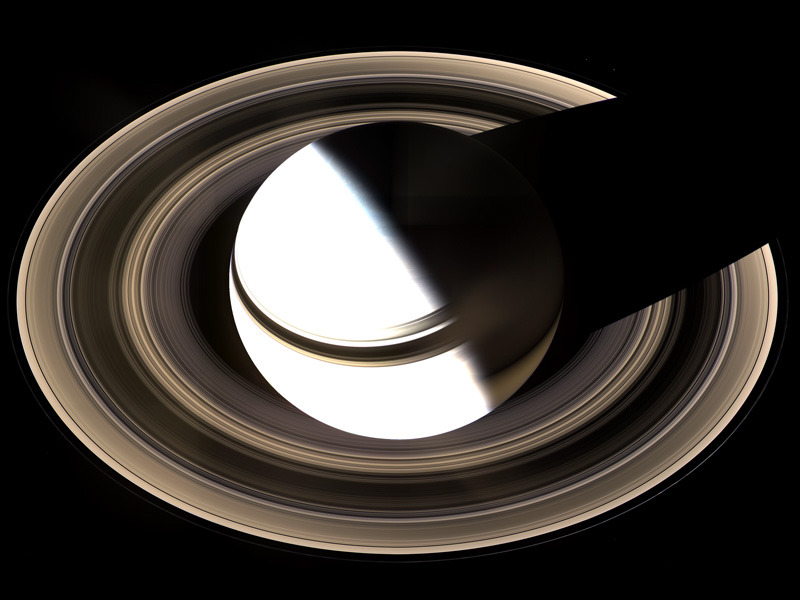
Two very enjoyable TV series are currently unrolling on the BBC, one on Astronomy and one on Music (two of the seven Liberal Arts, the first being traditionally regarded as the application of Geometry and the second of Arithmetic). They can be watched online, at least in the UK, and the associated websites provide excellent resources for educators. If you can't access them through the BBC, they are available as segments on YouTube. The Wonders of the Solar System by Brian Cox is full of spectacular scenery and special effects, and suitable for all ages. If this doesn't turn your children into astronomers, nothing will! Episode 2 was all about order out of chaos, the "beauty and symmetry that lies at the heart of the universe", and featured spectacular shots of Saturn's ring system. Sacred Music presented by Simon Russell Beale is glorious in a different way. After a recent episode I am a fan of Anton Bruckner, a devout Catholic contemporary of the better-known Brahms. This is the second series already, but presumably the whole thing is available on DVD. Do take advantage of the availability of these programmes if you can. For a better view of the Saturn picture above, go here.

How the World Is Made?


One of the topics in my book is so-called "sacred geometry". I didn't do it justice, of course. It need a lot more, and better, illustrations, but that wasn't an option at the time. So instead, as readers will know, I recommend the work of educator Michael Schneider. He seems to strike the right balance of enthusiasm and sanity, and his book is full of nice pictures and geometical constructions. Unfortunately, sacred geometry and number along with numerology and astrology have become a playground of the New Age. But while this should certainly engender caution, it should not put orthodox Christians off completely. These symbolic systems are part of the great Classical and Medieval civilization and were employed in the writing of Scripture and the building of the great cathedrals. We need to understand them better. The two great modern masters of the subject are Keith Critchlow (who teaches at the Prince's School of Traditional Arts) and John Michell. Shortly before he died, Michell completed How the World is Made, which is recommended by Michael Schneider. The book is illustrated by Michell with full colour images like these, and is published by Inner Traditions in the US and Thames and Hudson in the UK. I hope to review it in Second Spring, where I will try to say why I think the subject is important, even though I have to attach a strong warning, because it is mixed together (as you will see in Michell's book) with a lot of eccentricity and downright anti-Catholic prejudice.