"I See All"

Consisting of around 100,000 little black and white pictures with captions, interspersed with many gorgeous full-colour themed pages like this one, I See All (click on title for link) was billed as the "world's first pictorial encyclopedia" when it started appearing as a part-work in 1900, edited by Arthur Mee. Like the more recent Look and Learn, which I wrote about earlier, it is available online or in ebook format. My family inherited a set of the bound volumes, and I remember poring over it as a child. The imagination of a child invests such things with an intensity of life and colour - and an "atmosphere" - that grown-ups have mostly forgotten, until perhaps they chance on an old comic book or encyclopedia and experience a wave of nostalgia. We learn more from these experiences of beauty than we can put into words. I will be featuring some of the colour pages from this publication in future posts. They may be useful or inspirational to someone.

Purpose of education

At the end of Part Four of G.K. Chesterton's What's Wrong with the World comes this wonderful quote, which is worth pondering:
There was a time when you and I and all of us were all very close to God; so that even now the colour of a pebble (or a paint), the smell of a flower (or a firework), comes to our hearts with a kind of authority and certainty; as if they were fragments of a muddled message, or features of a forgotten face. To pour that fiery simplicity upon the whole of life is the only real aim of education...
I take this out of its context, where he is talking about female education in particular, to encourage you to go to the original. The passage ends with the famous motto: "if a thing is worth doing, it is worth doing badly".

Hallo

hallo

Heraldry

One way into a study of medieval history for some children is the aesthetic pleasure of heraldry - an imaginative delight in the visual symbolic language employed by feudal knights to distinguish themselves in battles and tournaments. The Church still has her own elaborate system of ecclesiastical heraldry, devising formal emblems for bishops and popes. Another angle would be especially appropriate for families reading Tolkien's The Lord of the Rings. Not only did Tolkien develop several viable languages for his "secondary world", including varieties of Elvish, but he even devised a series of mandala-like heraldic emblems for the different Elvish houses - you can find them online here or here. Some children will be fascinated with these, and they could be used in many different ways by homeschoolers (as I suggested in a previous post). For example, you could explore the symbolism of shapes and colours and how these relate to the story, or you could make black and white versions to colour in, or you could invent new ones (for example make a heraldic emblem for your own family or those of your friends). This in turn could lead you to compare Tolkien's symbology with traditional European heraldry. The subject also opens the door to possible discussions of symbolism in general, and of tradition, and of chivalry. You might like to read Chesterton on "pictorial symbols" in his book The Defendant, the chapter on Heraldry, or passages in his novel The Napoleon of Notting Hill where he talks about the "ancient sanctity of colours" and at the end of The Man Who Was Thursday where the six protagonists are clothed in symbolic vestments representing the days of creation... Then again, there is the whole subject of chivalry, that code of male ethics with which the Church tried to channel the aggression of feudal Europe in a more spiritual direction - but that calls for a separate post.

A Little Way

I have written previously about a radical form of homeschooling called "unschooling". Perhaps the best introduction to unschooling for Catholics is a book edited by Suzie Andres, which I had previously seen in draft. Now published under the title A Little Way of Homeschooling, it is based on the experiences of a group of home-schooling families who saw in John Holt the articulation not just of a theory but of a spirituality of education, akin to the “Little Way” of St Thérèse of Lisieux – a way of trust and simplicity. Being based on the actual experiences of families over many years, the book builds a certain confidence that unschooling is not merely an ideology, and need not be considered an impractical, idealistic dream. (I should mention also the delightful black and white line drawings.)

These parents know exactly what they are doing. Here is Karen Edmisten: "Most of us would probably agree that in many areas of our society specialization can and does lead to fragmentation. Parsing education into subjects, which are then studied in a vacuum apart from other subjects, can also lead to a fragmented understanding of both the subjects and the world around us." Contrast the method or "unmethod" described in action here, in which history is full of literature, literature marches through history, history is interlaced with science, and everything points to Faith, because everything is connected with the Reason of everything.

There is in fact a deep compatibility between the radical homeschool or unschooling approach to education and other manifestations of the Catholic understanding of human nature. Natural Family Planning, like unschooling, is regarded by many as an impractical ideal or an ideology, but when practised in the right spirit it reveals itself as something else entirely. The point about NFP is that it requires mutual respect and attentiveness to the whole person of the spouse. It should not be treated as just another instrument for achieving the aim of reducing fertility. For a couple to master NFP is to for them to grow in mutual love and knowledge. Similarly, unschooling is based on respect for the child and love between generations.

And yet the accounts in the book underline one important fact. It seems that, to be realistic, one must acknowledge that the success or failure of the unschooling as well as the homeschooling approach depends in large part not just on the individual child and his motivation, but on the family as a whole, especially the parents. The flourishing of any individual requires the right kind of attention from others. Precisely because unschooling is a spirituality, it will only succeed (on almost any measure of success) if the family is of a certain type or has a certain maturity. As Cindy Kelly says in her chapter, “The most powerful way to encourage my sons to enjoy a new area of learning is to model it myself and continue our dialogue about their interests and mine.” Not every parent is capable of that; not all have the leisure, confidence, or motivation to do so. But for those who do, I can imagine - after reading this book - that it might work beautifully well.

Back to the Circle

Reviewers of Beauty for Truth's Sake have been kind, but even the most ecstatic would admit that there are weak and even silly patches in the book, especially in the chapter called "The Golden Circle", where I play with some ideas relating theology and mathematics (inspired by Simone Weil's work and Vance Morgan's excellent book on her). Apart from anything else, I came up with a concept called "the Golden Circle" and wasn't able to develop it properly, since I lack the mathematical ability to do so. The "Circle" was simply a Golden Rectangle inscribed in a circle, which I thought one could use to explore the relations of Pi to Phi (Φ and π are connected together by the fact that the Golden Rectangle’s diagonal forms the diameter of the circle).

But my conception of the Golden Circle has evolved, and Michael Schneider has kindly redrawn it for me on the right (an intermediate stage was discussed in an earlier post). The Golden Circle itself is now a Golden Ring, shown in yellow. There are in fact three circles, one inscribed within the short sides of a Golden Rectangle, one inside the long sides, and one through the corners of the rectangle. On the basis of Pythagoras's Theorem, a large number of relationships can be established between areas and lengths in this figure, since we know that the circumference of a circle is Pi multiplied by the diameter, and the area is Pi multiplied by the radius squared. For example, the circumference of the middle-sized circle (the outside of the yellow ring) is Pi times Phi. But I'll leave you to work out what the rest of them are. Let me know sometime. It might make a nice exercise for a geometry class. The theology can wait.

Great Books and Western Studies

What is a "great book"? It is surely a book that stands re-reading many times, and deserves to be so read. And an educated person is one who knows the great books, and re-reads them. C.S. Lewis is quoted in Walter Hooper's Foreword to C.S. Lewis's Lost Aeneid (a wonderful new parallel text from Yale that could be used to teach Latin translation as well as introduce the Aeneid), as follows:
There is no clearer distinction between the literary and the unliterary. It is infallible. The literary man re-reads, other men simply read. A novel once read is to them like yesterday's newspaper. One may have some hopes for a man who has never read the Odyssy, or Malory, or Boswell, or Pickwick; but none (as regards literature) of the man who tells us he has read them, and thinks that settles the matter. It is as if a man said he had once washed, or once slept, or once kissed his wife, or once gone for a walk.
I feel better, now, about having read The Lord of the Rings so many times. Reading great books, however (even more than one), does not suffice to make a person educated. They need to be placed in a context, they need to be loved, and they need to open the door to other interests and other
fields of knowledge. In a world where there are no longer any common binding assumptions, a world without real traditions, clinging to the great books is like clinging to pieces of wood broken off a great ship that has long since sunk. We need a ship, an adequate vision of reality, and it is the job of education to build it...

That is the kind of thinking behind the curriculum and teaching of the Thomas More College of Liberal Arts in New Hampshire, which also offers programmes in Rome and Oxford, as well as other colleges, centres for Catholic study, and study-abroad programmes - such as the following from the Center for Western Studies, which offers a gap-year on Western civilization and its religious foundations:
Cultural critics are rightly concerned that we are declining as a civilization in the West. Once Western civilization imagined and created universities, hospitals, cathedrals, great art and music, all through the thoughtful combination of Greek and Christian thought that formed the basis for Western Reason (as exemplified in the writings of Augustine and Aquinas). Today, while we may sustain the outward appearance of these institutions, our culture has lost the general Christian convictions it once held, and the result is that these institutions are becoming hollowed-out shells that resemble them on the outside but inside are increasingly confused. Universities teach there is no truth, hospitals practice abortion, great cathedrals house more tourists than worshippers, fine art has gone from public significance to private museums, and we no longer believe there is a connection between faith and reason. We are living on borrowed capital from that earlier age of faith, and many historians and cultural critics are predicting that the West as a civilization is lost. While none would want to go back to a world of plagues, feudal warfare and no plumbing (which is still the way of life in many other parts of the world), we would like to regain anything that past generations have accomplished that is truly timeless, and find ways to apply those ideas to human life in our own day.
I have no first-hand experience of these gap-year programmes, but that too sounds like the right idea. And yet what do we do about other cultures, other civilizations? It's no use pretending we are not a multi-cultural society. And how do we revive faith, if that is the key to rebuilding our own civilization?

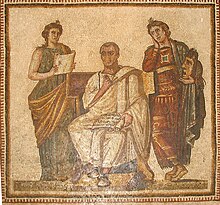
Illustration: Virgil, with Clio and Melpomene, from Wikipedia Commons.