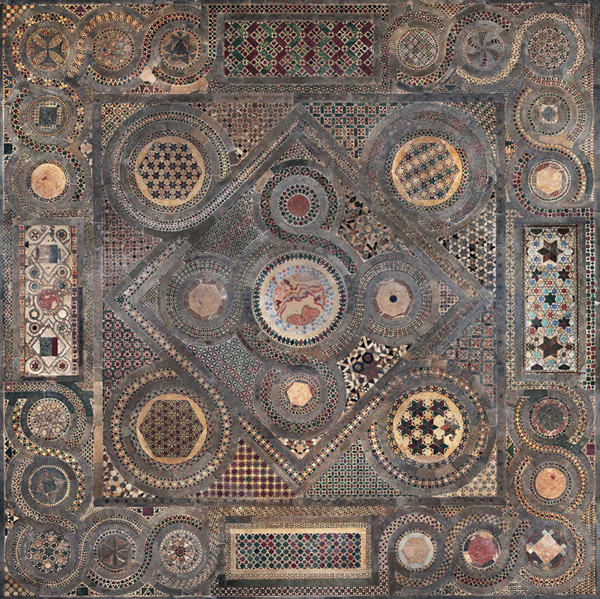
Diagram of the cosmos

The Cosmati Pavement in Westminster Abbey was underfoot when the Pope met the Archbishop of Canterbury in 2010, and when William married Kate in 2011. It is the traditional site of royal coronations -- 38 kings and queens have been crowned on this spot since 1268 (the symbolism of the ceremony is analysed by Aidan Nichols OP in his book The Realm). The Pavement is a kind of Western "mandala", a representation of the entire cosmos based on squares and circles and sacred numbers. I have posted about it before, but there are things to add. For one thing a much more detailed image of the entire Pavement is available here, on the Getty web-site.

The central disk of onyx represents the world, and the two sets of four roundels around it the four elements and four qualities unified by love, a symbol of the Great Chain of Being that bound the monarch to the lowliest subject and the highest angel under God, as in this fifteenth-century text:
"In this order, hot things are in harmony with cold, dry with moist, heavy with light, great with little, high with low. In this order, angel is set over angel, rank upon rank in the kingdom of heaven; man is set over man, beast over beast, bird over bird and fish over fish, on the earth, in the air and in the sea: so that there is no worm that crawls upon the ground, no bird that flies on high, no fish that swims in the depths, which the chain of this order does not bind in the most harmonious concord. Hell alone, inhabited by none but sinners, asserts its claim to escape the embraces of this order." (Sir John Fortescue, trans. On Nature, 1492.)
There was a Latin inscription to accompany the Pavement which described the age of the world from beginning to end as 19,683 years - the lifespan of the macrocosm conceived as a living creature. However inaccurate this is in terms of modern cosmology, it was an attempt to make the Pavement an image of the whole of space-time. We lost our "Theory of Everything", and modern science has been trying to get it back ever since.


Post-secularism

C. John Sommerville's book is a brilliant indictment of the modern university. He writes about it in an article published in Reconsiderations, available online. As he says there, "Secularism is an impoverishment of thought. Religion can be a way of opening our minds, and quite relevant to intellectual questions," adding:
To be clear, accommodating Christian and other religious voices would not make universities Christian. They would remain secular in the sense of being neutral. Religion wouldn’t rule. But it need not be ruled out. Universities wouldn’t be officially Christian unless they somehow privileged Christian viewpoints. That would not be good even for those Christian viewpoints. We need to keep them honest, and you do that by leaving them open to discussion.
This seems to be a good example of the right kind of "post-secularism" -- what many Catholic thinkers these days are calling "a new secularity" genuinely open to truth, unlike the "liberalism" wrongly so called, which closes the mind in advance by operating with a narrow conception of both reason and freedom.

Communio - an introduction

One of the great resources of modern Catholic thought is the international review Communio, edited in the English language by David L. Schindler. Founded in the wake of the Second Vatican Council by Hans Urs von Balthasar and Josef Ratzinger with Henri de Lubac SJ and Louis Bouyer, with the support of Karol Wojtyla in Poland (later John Paul II), it has never sold in huge numbers but has had and is having a huge if indirect impact on the Catholic Church through the fact that many of its contributors and editors have been appointed bishops and cardinals, often placed in key positions (Francis George, Marc Ouellet, Christoph Schonborn, Angelo Scola, and of course Ratzinger himself are the most obvious). Communio theology is an expression of the Catholic ressourcement or "back to the sources" movement that partly influenced the liturgical movement and the Second Vatican Council, and is certainly now influencing their interpretation and consolidation under Pope Benedict.

All around the United States there are Communio circles that meet to discuss articles from recent issues, but in the UK there seem to be too few subscribers in any one place to make this viable. Even in the States, many readers find Communio hard going. (Second Spring was founded, in part, to offer a more accessible way into this tradition of Catholic thought.) But if you are seriously interested in creatively orthodox Catholic thought, Communio is indispensable. The journal has a News page which is a good place to start, and this has links to a number of articles.

I have selected several important Communio articles for our own site, which you can find under author in our Articles section linked from the menu at Second Spring. Look for example under Bouyer, Crawford, Granados, Hanby, Henrici, Kaveny, Lopez, Melina, Nault, Olsen, Ouellet,  Schindler (D.L.), Schindler (D.C.), Schonborn, Scola, Sicari - as well as, of course, Popes Benedict and John Paul II. There are also several recent ones on Catholic social teaching to be found in the articles section of our "Economy" site - Abela, Berry, Cloutier, Healy, Schindler (both), and Walker. And for an introduction to Balthasar go here. I hope to write more about Communio and education in the future.

Tolkien - some thoughts

Here are some thoughts on the possible use of The Lord of the Rings by homeschoolers.

The first thing is not to impose the book as a lesson, but introduce it naturally at an early stage. Reading to a child every day, for example as part of a bed-time ritual that can start as soon as the child is capable of gazing at a picture, is the foundation of everything. (You know this already.) In the case of Tolkien, there are books that can be used much earlier than LoR – his Father Christmas Letters, Smith of Wootton Major, and of course The Hobbit – as well as dozens of books by other authors that can be read in conjunction with these, books by the other Inklings, traditional folklore from all over the world, and of course many wonderful passages from the Bible. It doesn’t matter that one is reading a book where the vocabulary is difficult – the meaning of a word can often be gleaned from context, although you should encourage questions and have a dictionary to hand.

When it comes to LoR, reading aloud continues to be important long after the child can read for himself. The sound of the words is important. Spend a bit of time getting the pronunciation of the Elvish words right (the Appendices contain some guidance) – something I never did. The magic is in the language, as Tolkien would be the first to tell you.

Once the story itself has come alive in the child’s imagination, and perhaps after it has been read more than once, it becomes possible to explore a range of topics suggested by the book. Let’s consider Language, Philosophy, Religion, Nature, Geography, History, Mythology, and Art.


First, Language. Many children try their hand at making up a secret language or code. Why not give them a helping hand, and use the game to teach them gradually about the basic rules and reasons for grammar and syntax, the possible use of word endings, and the shapes of letters? You could take a side-trip into the art of calligraphy, in which Tolkien was adept. Keep a good dictionary, and perhaps especially an etymological dictionary, to hand, and talk about the ways words have evolved. Often children’s spelling and also word-comprehension can be massively improved by paying a little attention to the composition of the words we use. It is, by the way, extremely helpful if a child can be taught to speak at least one other language while very young. It becomes much harder later on. Some children might like to try learning Elvish.

Philosophy. We are fortunate in having Peter Kreeft’s excellent book, The Philosophy of Tolkien, to refer to. This will open up the whole world of philosophical thought to anyone who loves the story. (Children, of course, are as much philosophers as anyone else, and more so than many adults, whose ability to wonder and to question has long since atrophied.)

Religion. As my own book, Secret Fire (in the USA, The Power of the Ring) pointed out, not to mention Joseph Pearce and many other authors, Tolkien’s work is permeated with religious themes and “atmosphere”. I don’t think it would be a good idea to treat LoR as a mere religious allegory and attempt to decode it – apart from anything else, this would be contrary to Tolkien’s intention (he had a “cordial dislike” of allegory). Rather the way to connect the book with Religion is by subtly directing attention to the plot, which illustrates the way Providence works in the real world, to the characters and how they develop virtues by struggling against temptations of various sorts, and to the moments when beauty reminds us of the transcendent. It should be possible also to talk about the way we find meaning in our own lives by answering the call to become a hero and following a quest of our own. Each of us is different, just as each member of the Fellowship of the Ring is different and has his own unique part to play. Our lives have a purpose, and we are part of a Great Story. But it might be better to let the book communicate these ideas in its own way and not turn them into a Lesson Plan.

Nature. Tolkien describes the natural word of Middle-earth with great love and attention to detail, so that one feels one has actually been there. You could examine his descriptions, study the flowers and plants and birds he refers to, and try to find places that remind you of parts of the book. Tolkien loved to go on walks in the countryside, and was always dawdling to look at the flowers and trees (unlike his walking companion C.S. Lewis, who liked to walk faster). Trying to draw or paint flowers or landscapes is the best way to get to know them.

Geography. Start with the maps. A fascination with maps and how to read and draw them will stand children in good stead later. Make similar maps of your own neighbourhood or places you visit. Pore over atlases of the real world, and try to see how Tolkien thought Middle-earth might have evolved into the Europe that we see today. Compare the maps of Middle-earth at the time of the War of the Ring with maps in some of Tolkien’s other, posthumously published works, of Beleriand and the other kingdoms in the earlier Ages. (The Encyclopedia of Arda might help.) Discuss how the forces of nature can gradually or suddenly reshape a landscape, raising or levelling mountains, drowning islands and plains, eroding new valleys. Convey something of the fascination of Dwarves with the “bones of the earth”, and if possible take your children to see some “glittering caves”.

History. LoR is about nothing if not history, and the “long defeat” of our exile from Eden, and the yearning for paradise which keeps us building civilizations, and our need for redemption (the “healing of Arda”, as it is called in The Silmarillion). To explore the history of Middle-earth using the Appendices, creating time charts and writing little essays on each of the invented cultures, might be a good way to get children interested in real history. With older kids you could look at what inspired Tolkien – the Anglo-Saxon culture, especially, and to some extent the Celtic. Connect Numenor with Atlantis, and read a bit of Plato.

Mythology. Here you have a golden opportunity to go on from LoR to the Norse and Icelandic sagas, and then to compare Tolkien’s “Ainur” (described in The Silmarillion) with the pantheons of gods not just in the Norse mythology but in Greek and Roman too. Read the tales of King Arthur and his knights, and the legend of Troy, which have so many echoes in LoR. Compare the creation story in The Silmarillion with those of other mythological traditions. Reflect with older children on the relation of mythology to truth – that these are not just failed attempts to explain the world scientifically, but contain poetic insights into truth, and a kind of symbolic metaphysics.

Finally, Art. There are numerous examples of drawings and paintings in different styles inspired by Tolkien’s writing, so it would be easy to look at these and develop an interesting Art class. Tolkien himself illustrated many of the events and scenes in the books, and even designed colourful heraldic designs for the different Elvish “houses” or families. Why not show these, and encourage children to design similar symbols for their own family and friends? Move on from there to look at heraldry and coats of arms, used not only in feudal Europe but in the modern Church. This can help to awaken an appreciation of symbolism, as well as a sense of colour and design (as well as connecting back to History).

I hope these sketchy hints are of some use. Do feel free to comment or submit other ideas. These are just initial thoughts, but I hope to include a more developed version of this essay in my new book eventually.
The Lord of the Rings for homeschoolers

 At a recent Tolkien-related event in Italy I was speaking about the theme of "friendship" in The Lord of the Rings. In a way it is could be called a central theme, since the story is all about a Fellowship. Of course the novel is about many other things as well. Tolkien himself said it was about Death and Immortality, and on another occasion that it was about "the ennoblement of the humble" (e.g. Sam Gamgee and the Hobbits). But it is also about Marriage, Myth and reality, Heroism and Virtue, Temptation and Freedom, Power (true and false), Beauty, Technology, Nature, Creativity, Social Order, the Fall, and Language.... The novel could also be used quite naturally by home-schoolers to get children interested in and thinking about Geography, History, Ethics, Politics, Language, Poetry, Natural History, Mythology, and Philosophy. Is anyone interested in hearing more about this idea?

New Evangelization through Drama

The Quality of Mercy
In his Letter to Artists, Pope John Paul II spoke of art as a bridge to religious experience: “I appeal to you, artists of the written and spoken word, of the theatre and music... I wish to remind each of you that you are invited to use your creative intuition to enter into the heart of the mystery of the Incarnate God and at the same time into the mystery of man.” The late Pope himself had been a playwright and keen patron of drama, and worked with the “Rhapsodic Theatre” in Poland. Thus the beatification of John Paul II on Divine Mercy Sunday (1 May 2011) was both the occasion and the inspiration for LĂ©onie Caldecott’s play, “The Quality of Mercy”, performed over three nights preceding the beatification at Oxford’s Catholic Chaplaincy. Part Theatre of the Word and part Ballet of the Word, it was a multi-levelled theo-drama about youth and age, despair and modernity, vocations to marriage and celibacy. The play was the second from Divine Comedy Productions, set up at the Oxford Oratory last year. In London, Sarah de Nordwall’s "Bard School" is also concentrating on poetry and drama as a way of expressing and communicating faith. In the United States, Fr Peter John Cameron OP is also an accomplished playwright and director. An article by him on this theme is available online here.

Philosophy is unavoidable, of course. As Chesterton long ago noted, everyone is a philosopher; whether you unconsciously absorb your philosophy from somewhere else (such as the newspapers) or think it through for yourself. And how you think about things shapes the way you act and behave, so nothing is richer in practical implications (even for art). Do you believe in God? But what kind of “God” is being talked about? What does the word mean to you? I have tried to address that question online here, and the main Second Spring web-site contains many useful articles on philosophical topics. Nevertheless, philosophy is never going to be a very effective means of evangelization. People open their minds, or change them, for other reasons than a good argument. “Heart speaks unto heart”, not head unto head, as Newman realized. The Christian faith places us under an obligation to communicate it where possible. But effective communication involves the imagination and the spirit, not just the reason or the intelligence.

Just as we cannot separate the virtues of faith, hope, and love, so we cannot separate truth, goodness, and beauty. It is the heart where they join together. The way we live and the beauty we produce are the most eloquent expression of the truth we believe. You cannot communicate a truth that has not changed you, and we are changed only by a truth that we recognize as in some way beautiful.

Paying attention

Attention to the child is the key to the teacher’s success, and the child’s own quality of attention is the key to the learning process, or so Simone Weil asserts in her essay “Reflections of the Right Use of School Studies”. She almost goes as far as to say that the subject studied and its contents are irrelevant; the important thing, the real goal of study, is the “development of attention”. And why? Because “prayer consists of attention”, and all worldly study is really a stretching of the soul towards prayer.

“Never in any case whatever is a genuine effort of the attention wasted. It always has its effect on the spiritual plane and in consequence on the lower one of the intelligence, for all spiritual light lightens the mind.” An attempt to grasp one truth – even if it fails – will assist us in grasping another. “The useless efforts made by the Cure d’Ars, for long and painful years, in his attempt to learn Latin bore fruit in the marvellous discernment that enabled him to see the very soul of his penitents behind their words and even their silences.”

Attention is desire; it is the desire for light, for truth, for understanding, for possession. It follows, according to Weil, that the intelligence “grows and bears fruit in joy”, and that the promise or anticipation of joy is what arouses the effort of attention: it is what makes students of us.