Queen of the Sciences


Here is a passage from Fr Robert Barron's wonderful book The Priority of Christ (pp. 155-6):

In the thirteenth century, Bonaventure maintained that all of the non-theological arts and sciences taught in the university find their proper center in theology, that science which speaks directly of Christ the Logos. As the rationality of God the creator, Christ is the physical, mathematical, and metaphysical center of the universe and hence the point of orientation for all of the sciences dealing with those dimensions.

In the nineteenth-century, at the high-water mark of modern foundationalism, John Henry Newman felt compelled to call for the re-insertion of theology within the circle of university disciplines. Following the inner logic of Christian revelation, Newman, like Bonaventure, saw that theology not only should be around the table, but must be the centering element in the conversation, precisely because it alone speaks of the creator God who is metaphysically implicit in all finite existence.
A few lines later he adds: "Newman saw that once theology is displaced, some other discipline necessarily takes its position at the center and thereby disturbs the proper harmony among the sciences, for no other discipline has the range or inclusiveness properly to hold the center."

The same argument is made powerfully in Alasdair MacIntyre's recent book, God, Philosophy, Universities. But what is this "proper" harmony that Barron appeals to? Why is only theology capable of "holding the center"? The point is that, while theology cannot determine the methods or content of the individual sciences, it alone is concerned with that which transcends them all. It is a place-holder for that which connects everything - for what Barron terms "co-inherent relationality." Theology as a formal discipline is a quest for that relationality. Without it, rationality itself fragments and falls apart.

Icon by Solrunn Nes (www.icon-painting.com). "Just as the Virgin was called to offer herself entirely as human being and as woman that God's Word might take flesh and come among us, so too philosophy is called to offer its rational and critical resources that theology, as the understanding of faith, may be fruitful and creative. And just as in giving her assent to Gabriel's word, Mary lost nothing of her true humanity and freedom, so too when philosophy heeds the summons of the Gospel's truth its autonomy is in no way impaired. Indeed, it is then that philosophy sees all its enquiries rise to their highest expression" (John Paul II, Fides et Ratio, 108).

New educational initiatives

I thought it would be worth drawing attention to some notable new initiatives in education. First, the Living Water College of the Arts in Alberta, Canada. This is committed to the training and development of Christian artists across a wide range of genres including theatre and film. Second, the C.S. Lewis Foundation in California has announced the creation of C.S. Lewis College in Northfield, Massachusetts dedicated to "mere Christianity". Third, there is the Theotokos Institute for Catholic Studies at St David's Catholic sixth-form College in Wales, dedicated to "theology before division" (of the Christian east and West, that is). Fourth, from within the Orthodox tradition, the Cappadocian House of Studies in Art and Nature (at the moment more of an aspiration than an actual House). Fifth, here in Oxford the demise of the Franciscan Hall of the university last year, Greyfriars, has led to two new initiatives - St Bede's Hall and the Centre for Franciscan Studies, which is currently sponsoring a series of lectures in the Taylorian (mine is on 24 May).

And, of course, I have already mentioned what is going on at Thomas More College with David Clayton's "Way of Beauty", and the work of pioneer educationalist Michael Schneider. When I hear of other relevant projects I will mention them in future postings. [Here is one added later: the Ignatius-Angelicum Liberal Studies Program started by Fr Joseph Fessio SJ. The announcement in May 2010 reads "Ignatius Press and Angelicum Great Books Program have joined with cooperating colleges in the US, Australia, and Europe, to launch the Ignatius-Angelicum Liberal Studies Program (LSP), an online course of studies combining the best of home and distance learning with live, online classes."]

God's Mathematics


Charlotte Ostermann recently reminded me of a wonderful passage in St Bonaventure that sums up the ancient understanding of how mathematics leads us to God:

"...since beauty and delight do not exist without proportion, and since proportion exists primarily in numbers, all things are subject to number. Hence 'number is the principal exemplar in the mind of the Creator,' and in things, the principal vestige leading to Wisdom. And since number is most evident to all and very close to God, it leads us, by its sevenfold distinction, very close to Him; it makes Him known in all bodily and visible things when we apprehend numerical things, when we delight in numerical proportions, and when we judge irrefutably by the laws of numerical proportions." - St Bonaventure, The Journey of the Mind to God.

Regenerate science


Sitting in a meeting recently with a group of people each of whom was staring down into one or other electronic gadget, the following quotation came to mind:

“In our contemporary world it may be said that the more a man becomes dependent on the gadgets whose smooth functioning assures him of a tolerable life at the material level, the more estranged he becomes from an awareness of his inner reality. I should be tempted to say that the centre of gravity of such a man and his balancing point tend to become external to himself: that he projects himself more and more into objects, into the various pieces of apparatus on which he depends for his existence. It would be no exaggeration to say that the more progress ‘humanity’ as an abstraction makes towards the mastery of nature, the more actual individual men tend to become slaves of this very conquest.” – Gabriel Marcel, Men against Humanity (London: Harvill Press, 1952)

Technology is far from neutral, as it is frequently assumed to be in both popular and scholarly writings on this subject. “The medium is the message” (McLuhan), and a technology is not simply a technique that may be employed for good or ill. It bears within itself a value system and a worldview - perhaps even a metaphysics and a theology. Telephone, television and the internet, for example, change our sense of space and time, and have a variety of effects on the relationships within the family and the wider social community. Some of these effects will be humanly beneficial, others less so, but an assessment of the technology is not possible without paying attention to the overall pattern of these effects, and to the purpose or function of the technology in relation to the purpose of human life itself. In what respect is a given tool actually serving the true end of man?

As a matter of fact, I think the portable computers we all use now are a great boon, and I could hardly do without mine. But this does not stop me noticing that this very dependence is a kind of warning sign. We are addicted to technological change in a much more serious way than simply psychologically. This makes “technology assessment” impractical, to say the least. We are running too fast to stop and assess anything – if we are not to stumble over our own feet and be left behind in the race, we have to assume we are running in the right direction.

In his classic work, The Abolition of Man, C.S. Lewis compares the Baconian scientist with Goethe’s Faustus. “For the wise men of old the cardinal problem had been how to conform the soul to reality, and the solution had been knowledge, self-discipline, and virtue. For magic and applied science alike the problem is how to subdue reality to the wishes of men: the solution is a technique; and both, in the practice of this technique, are ready to do things hitherto regarded as disgusting and impious - such as digging up and mutilating the dead.”

But Lewis is no Luddite. He thinks another kind of science and technology is possible. He goes on, “The regenerate science I have in mind would not do even to minerals and vegetables what modern science threatens to do to man himself.” Goethe and the Romantics were on to something. My book is trying to point in that direction, to encourage us to reflect on the elimination of formal and final causes from science, and the disconnectedness of our lives, and to begin to imagine another way of doing business, another way of making scientific progress – a “regenerate” science, perhaps.

Image by Giovanni Sades from FreeDigitalPhotos.net

The Pope on Beauty


The "way of beauty" is the theme of the Pope's recent address to artists on 21 November 2009 in the Sistine Chapel. In it he writes - quoting both Hans urs von Balthasar and Simone Weil, who are influences on the book on which this blog is based (see left), and building on the Letter to Artists of Pope John Paul II - as follows: "Beauty, whether that of the natural universe or that expressed in art, precisely because it opens up and broadens the horizons of human awareness, pointing us beyond ourselves, bringing us face to face with the abyss of Infinity, can become a path towards the transcendent, towards the ultimate Mystery, towards God.... In this regard, one may speak of a 'via pulchritudinis,' a path of beauty which is at the same time an artistic and aesthetic journey, a journey of faith, of theological enquiry.... Simone Weil wrote in this regard: 'In all that awakens within us the pure and authentic sentiment of beauty, there, truly, is the presence of God. There is a kind of incarnation of God in the world, of which beauty is the sign. Beauty is the experimental proof that incarnation is possible. For this reason all art of the first order is, by its nature, religious.'"

The Pope has also recently spoken very eloquently of the beauty of the medieval cathedrals, one of which, the Cathedral of Orvieto, is featured in the photograph. There he speaks of "a much broader form of reason, in which the heart and reason come together. This is the point. This, I think, is in some way the proof of the truth of Christianity: the heart and reason come together, beauty and truth touch. And to the extent that we are able to live in the beauty of truth, so much more will faith again be able to be creative, in our own time as well, and to express itself in a convincing artistic form."

The Way of Beauty program


Readers of my book and blog might be interested to know that a colleague and friend, David Clayton, with whom I worked on these ideas in Oxford, is now the Artist in Residence at Thomas More College of Liberal Arts in New Hampshire. There he has developed a course based on the traditional quadrivium called THE WAY OF BEAUTY. He writes, "Literature, art, music, architecture, philosophy—all of creation and potentially all human activity—are bound together by this common harmony and receive their fullest meaning in the Church’s liturgy. This course teaches a deep understanding of these principles and their practical application through both lectures and workshops." If you follow the link you'll find out more about this wonderful educational initiative. David's articles can be found on the New Liturgical Movement website and are permanently linked from my Links list on the left. David is also the author of a Distance Learning programme called ART, BEAUTY AND INSPIRATION offered through the Maryvale Institute in the Archdiocese of Birmingham. There is also a recent interview with David on Zenit.

An interesting article inspired by David Clayton's writing and that of Robert Sokolowski is available on Jake Tawney's blog, entitled "Content and Form - From Linguistics to Abstract Art".

Image: Icon at Pluscarden by David Clayton, based on the crucifix at San Damiano.

The Fate of the Cross


Sitting in an airport recently for several hours - a perfectly smart, pleasant, efficient airport - I had occasion to look around and realise something. Not only could I have been in almost any country of the world, and therefore I was in some sense "nowhere", but I was in a space where signs predominated over symbols. Everywhere I looked there were signs: pictures, advertisements, instructions, those little "icons" that tell you where the toilets are, or ground transportation. But the whole place had been constructed with absolutely no sensitivity to the natural symbolism of shape and number and light. Of course, that didn't mean that symbolism had been eliminated, just that it was inadvertent. The modern world tends to eliminate symbolism, because symbols, unlike signs, point us to something outside this world, something deeper and more real than toilets, or things to buy.

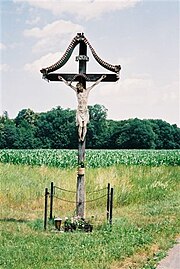
The final elimination of symbols that speak of the transcendent has not yet taken place, but the recent judgement of the Court of Human Rights that Italian schools must remove crucifixes from their walls shows that the struggle is intensifying. A crucifix may be treated as a sign, in which case it points to the social phenomenon of Christianity, much as a Union Jack represents the United Kingdom. This is how it is being treated by the Court - as the flag of Christianity. But the crucifix is also a concatenation of symbols, a symbol par excellence, the symbol of symbols. In a way, the attack on the crucifix is itself symbolic - of an attack on symbols in our culture.

It is more important than ever that our education should give special attention to cultivating the symbolic imagination. James Taylor's Poetic Knowledge is a helpful resource. What he calls "poetic knowledge" is the intuitive, tacit, connatural way of knowing that tends to be neglected in the pursuit of mere information. Catechesis, too, needs to take more account of the symbolic dimension of scripture and the sacraments. More on that another time.